In Memorium Sand Creek Massacre Descendant

William Lee ‘Sage Man’ Pedro, In Memoriam, by Donald L. Vasicek

2006-03-26 | William Lee “Sage Man” Pedro
Sand Creek Massacre Descendant
Southern Arapaho

I was informed today that William Lee “Sage Man” Pedro, a Sand Creek Massacre descendent, a descendant of John Smith, and a Southern Arapaho man, who has been proactive with respect to the re-burial of remains taken from the Sand Creek Massacre, died of a brain injury from a fall while shopping with his wife.

Lee, as I was honored to be able to respectfully call him, was a passionate man, whose eyes would tear and sear me when he talked about the atrocities at Sand Creek with me. Although he took me to task for being a white man who could not be trusted simply because I was a white man, and who met me nose-to-nose on several occasions to make sure I was on the straight and narrow with his people and him, he did support my efforts to tell the Cheyenne and Arapaho people’s stories via their oral histories in the educational video and documentary film. He will be missed. I gave one moment today for Lee. I looked up into the sun. My eyes drifted to green grass blades pushing their way into new life on the ground. I saw a majestic maple tree reaching for the blue sky. Then, the greening buds on its branches. A dog barked. It echoed against the silence of this moment, and I knew Lee is now with his ancestors.

I am hopeful that each of you can honor him for one minute out of your busy lives. He was an aboriginal, a native, a man who was part of the roots of America, and its rich, American history. He agonized over the way his people have been treated for nearly four centuries by the United States government and other Americans. Lee’s heart wrenched with sadness, with anger, and with pride over this.

Honor him as he has honored us.

Peace and Love,
Donald L. Vasicek
Olympus Films+, LLC
http://www.donvasicek.com
dvasicek@earthlink.net
Witness Accounts

“Captain Silas S. Soule/Lt. Joseph Cramer Letters”
By Donald L. Vasicek

On November 29, 1864, about 700 Colorado 1st & 3rd Regiment troops and troops from New Mexico, slaughtered over 400 (Sand Creek Massacre Descendant and Southern Cheynne Chief Laird (Whistling Eagle) Cometsevah gave filmmaker, Donald L. Vasicek this figure, basing it on what has been passed through Chief Cometsevah’s family from his great-great grandfather who survived the Sand Creek Massacre)men, women, and children in the southeastern Colorado Territory. This act became known as the Sand Creek Massacre.

Lt,. Captain Silas S. Soule wrote a letter dated December 19, 1864 from Ft. Lyon, C. T., to Major Ed Wynkoop, his commanding officer. It reads in part what he witnessed at Sand Creek, “…hundreds of women and children were coming towards us and getting on their knees for mercy. Anthony shouted, ‘Kill the sons of bitches’ ”

The letter goes on to say in part, “…the massacre lasted six to eight hours…I tell you Ned it was hard to see little children on their knees have their brains beat out by men professing to be civilized. Some tried to escape on the Prairie, but most of them were run down by horsemen …They were all horribly mutilated. One women was cut open and child taken out of her, and scalped…”

In a letter dated, December 19, 1863, Fort Lyon, C.T.,Lt. Joseph Cramer wrote to Major Ed Wynkoop, his commanding officer a letter about what he witnessed at Sand Creek. It reads, in part, “…“Dear Major, This is the
first opportunity I have had of writing you since the great Indian Massacre, and for a start, I will acknowledge I am ashamed to own I was in it with my Co. Col. Chivington came here with the gallant third, known as Chivington Brigade, like a thief in the dark…marched all night up Sand, to the big bend in Sandy…and came to Black Kettle’s village of 103 lodges, containing not over 500 all told, 350 of which were women and children…We lost 40 men wounded, and 10 killed. Not over 250 Indians mostly women and children, and I think not over 200 killed, and not over 75 bucks. With proper management they could all have been killed and not lost over 10 men. After the fight there was a sight I hope I may never see again…Bucks, women and children, were scalped, fingers cut off to get the rings…a squaw ripped open and a child taken from her, little children shot, while begging for their lives (and
all the indignities shown their bodies that ever was heard of)(women shot while on their knees, with their arms around soldiers a begging for their lives)…Most of the Indians yielded 4 or 5 scalps…”

The letter continues in part, “…Black Kettle said when he saw us coming, that he was glad, for it was Major Wynkoop coming to make peace. Left Hand stood with his hands folded across his breast, until he was shot saying, ‘Soldiers no hurt me – soldiers my friends.’

About 130 years after the Sand Creek Massacre, the 1990’s, Florence Blunt (1894-1969)was going through two stored trunks of a family member who was a rancher who was in the habit of taking supplies to Fort Lyon before and after the Sand Creek Massacre. She found Captain Silas S. Soule and Lt. Joseph Cramer’s letters. The lady’s daughter, Linda Rebek of Evergreen, Colorado, retains possession of the letters. She is seeking someone to appraise the letters to see what they are worth. The American Indian Genocide Museum needs help in locating an appraiser and funding to pay for the appraiser and acquisition of the letters to place in the museum.“

What Caused The Sand Creek Massacre

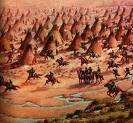
Depiction of The Sand Creek Massacre
[Depiction of the Sand Creek Massacre]

The Sand Creek Massacre was caused by a variety of reasons.  Extensive research for the past several years has revealed that communication played an integral role.  Colorado Territorial Governor John Evans issued an order in the summer of 1864 to all Indians.  He ordered them to report to the nearest fort to give up their weapons with a promise that they would be given provisions and supplies and be taught how to plant and grow crops.  He said that those who do not report, would be considered criminals.  He added that they would be hunted down, tried and sent to prison.  The Cheyenne people did not receive the order until after three months from the time it was issued.  By the time they reported to Fort Lyon, the die had been cast for them. Evans received information that the Sioux and Cheyenne were gathering at Smoky Hill.  It was reported that they were going to attack Denver City, population, 15,000.  This came on the heels of the brutal murders of the Hungate family in June of 1864.  Evans wired Secretary of War, William Seward, twice in the summer of 1864 for 10,000 troops because of his fear that a major attack on Denver City was imminent. He was turned down both times.  The American Civil War was taking place then, and that is where troops were being deployed.

The Cheyenne did meet with Governor Evans, Colonel John Chivington and several others at the meeting of Camp Weld in 1864.  Evans ordered the Cheyenne to report to Fort Lyon to turn in their guns.  Once that occurred, they were told to go to Sand Creek, about 40 miles away to wait for supplies, provisions, and others to teach them how to plant crops in place of following the buffalo, the life blood of the Cheyenne people, as well as numerous other Indian tribes.

Governor Evans and Colonel Chivington ran for Congress.  Chivington, an Indian hater, who said, amongst other things, “Nits make lice”, when speaking with a group of people.  “Nits”, according to Chivington, were Indian children.  Chivington was defeated in his run for Congress.  Evans withdrew his name from the ballot.  At the same time, Colorado Territory voters, voted down the chance for the Colorado Territory to become a state.

At the end of November in 1864, 700 troops led by Chivington, attacked over 500 Cheyennes at Sand Creek.  Arapaho and Kiowa people claim their ancestors were camping at Sand Creek as well.  It was well known, at the time, that Arapaho and Kiowas always camped about 8 miles away from the Cheyenne. Many Cheyenne, based on what their Sand Creek Massacre ancestors passed down to them, is that there were no Arapaho people at Sand Creek.  

Even though the Sand Creek Massacre National Historic Site is over 12,000 acres in size, the Cheyenne people, based primarily on their spiritual experiences at the site, say the Sand Creek Massacre, took place at Dawson’s Bend, a bend in Sand Creek.  Dawson’s Bend was named after William Dawson who maintained a ranch on the site for nearly 40 years. Troopers shot, mutilated, raped, burned, hung, decapitated, and literally slaughtered over 400 Cheyenne people there.  These claims evolved out of survivors of Sand Creek who passed their stories (oral histories) to their families.  This particular number of those slaughtered and murdered was given to this filmmaker by Southern Cheyenne Chief Laird (Whistling Eagle) Cometsevah in 2004. Another contributor to the Sand Creek Massacre were corrupt Indian agents.  Rather than dole out supplies and provisions sent by the United States government to honor the 1861 Treaty of Fort Wise, some Indian agents sold the goods for their own profit.

These cowardly actions of greed and self-interest, in turn, caused virtual starvation for Cheyenne people, poverty, vulnerability, and hopelessness for all.

More, later….