Tag: America

  • Haiti and Poverty-Stricken America

    The tragedy in Haiti is unparalleled. The call for help
    from around the world is needed, to say the least.

    The question:

    What does it take to get an equal call to citizens of the
    United States to help out American citizens who
    have, are and will be experiencing metaphorical
    earthquakes of their own?

    Native Americans. Homeless war veterans. The
    homeless. Poverty-stricken people in the United States.
    Those who have lost their jobs and homes and had
    and are having their lives ruined because
    of ignorant, fear-filled human beings like George Bush
    and Richard Cheney, who plunged the United States
    of America into a meaningless war that caused the
    murders of thousands of Americans, Iraquis, and
    others, and in turn, created the economic turmoil
    that has placed the United States on the brink of
    financial disaster. These two individuals live in
    warm, safe, secure homes, and are revered in some
    circles, as wonderful men. With what legacy will history
    books credit them? Because America honors those who
    serve in public office, for some strange reason, more
    than any other American, they will prevail with
    their new libraries, etc.

    Who is going to create a text message number for
    people to call in to donate money to help out those
    Americans who were figuratively destroyed in the
    past by greed and self-interest like these two men?
    Who? And when?

    The United States has always been helpful to
    people in other countries. It has helped make
    America, in many people’s eyes, the great
    country that it is. It is almost cliche. What
    about Americans who need help? Think
    about it. Where is the outpouring to
    help Americans in need, like what is
    going on in Haiti now? Where is it,
    folks? And that is not to slight Haitians
    one bit. The horror they are
    experiencing is unimaginable. We
    must help them out. I’m simply
    saying that we have Americans
    in America who are experiencing
    the same kind of horror.

    Food. Shelter. Clothing. Possibly a bit of
    recreation. Where has it gone for thousands
    of Americans who have been, are, and will
    be devastated by this metaphorical earthquake
    that plagues Americans as a people?

    It is time for the United States of America to
    put forth the same effort it does to help out
    Americans like Haitians are being helped now.

    It is time, or, the infrastructure of America will
    continue to decay, and die.

    It is time.

    And for those of you, after reading this, who will want to compare me to Rush Limbaugh’s bellowing about American citizens’ income tax money that goes to Haiti, forget it. Rush Limbaugh is a squeaky
    conservative. Oiling his hinges would only be a beginning to turning
    around his idiocy. For me, my hinges are oiled. I am tired of those who try to make a show by giving others money, when many Americans in their backyards are struggling to stay alive.

    We have always given as Americans. So much so,
    we are blinded to the fact that there are thousands
    of Americans who need the same kind of help
    Haitians are struggling to receive. If you want to
    argue this point, before you do, I encourage you
    to visit some Native American reservations in
    the United States. Visit them. Roll in the dirt,
    feel their earth. Go to the Conoco convenience
    stop in Lame Deer, Montana. Stand in line
    with what you want to purchase. Observe
    those standing in line with you. Who are
    they? They are Native Americans who live
    on a poverty-stricken reservation where
    drug and alcohol abuse stalks each Native
    American who lives there, like actually,
    forced to live there, because their ancestors
    were shot and killed when they resisted
    attempts at curtailing their rights to
    follow the buffalo and to live free.

    Go there, my friends, before you flap
    your tongue about me, and my
    pontificating. Sit and ponder there.
    Then, tell me that America’s
    indigineous people in addition to
    those Americans who live in
    cardboard boxes under bridges
    do not need the kinds of help some Haitians
    are presently receiving.

    Tell me. Tell me. Churches who
    spend all of their might on helping
    people in other countries who are
    experiencing plight, poverty, hunger,
    disease, AIDS, and a host of other
    horrifying things that most Americans
    do not. Why is it that there are
    Americans in America who live
    in “Third World” countries, or as
    some idiots say, “developing nations”,
    which is hilarious to me, here in
    America? Check out Pine Ridge,
    folks, before you attack me for my
    presence of mind here.

    Check out parts of Los Angeles,
    New York City, Chicago, Denver,
    etc. Everywhere, and anywhere you
    go in the United States, you simply
    need to open your eyes, and you will
    see human devastation.

    So, close your mind. Kick me in the ass
    for this article. Say that I am an idiot.
    It doesn’t matter. My plea is simply to
    open your minds and eyes to the
    devastation in America as you have
    opened your minds and eyes to
    Haitians. Americans need your
    help as well. They also need your
    hearts and your love. Who is the
    first one to raise their hand and
    pledge, as you are pledging to
    Haiti, to exude the same passion
    for America’s people who are
    less fortunate than you? Who?

  • “Notes from Dachau and Anne Frank’s House”

    June 18, 2008 – Centennial, CO – Donald L. Vasicek, award-winning writer/
    filmmaker for the Sand Creek Massacre documentary film recently traveled to
    Europe.  Amongst his stops was Dachau, a Nazi concentration camp about nine
    miles or fifteen kilometers northwest of Munich.  Vasicek, known for his campaign
    to educate others about American native people, nevertheless, was stunned by
    what he saw and experienced at Dachau and in Anne Frank’s house in Amsterdam.
    Part of his notes are as follows:

    ENTRY TO DACHU
    ENTRY TO DACHU

    “To escape from Dachau, one had to sprint across an eight-foot wide
    strip of grass.  The grass was nurtured there for prisoners.  It encircled
    the interior of the camp.  If one stepped on the grass, they were shot.  If
    one made it past  the grass to a v-shaped cement moat that also surrounded
    the interior of the camp, they had to scamper down into the moat, up the other
    side of it to barbed wire that was spread on up-sloping ground.  An, at least
    ten-foot high electric fence with barbed wire curled on top of it like large circles
    drawn with barbed spikes on it, was the last barrier to escape from a place
    where an estimated 50,000 human beings were murdered.
    ENTRY (ORIGINAL)TO DACHU
    ENTRY (ORIGINAL)TO DACHU

    “As I toured the camp and listened to the tour guide’s description of the camp,
    what was there, and what is presently there and why, I felt like I had stepped
    into the past.  All of the books I had read,  all of the movies and documentary films
    I had seen, all of what I had learned about that horrific time, came to the surface there.  I got a
    dose of reality.  I could feel the terror, the pain, and the sorrow.  I constantly
    asked myself, how could anyone create such a horrifying place?  I was stunned
    to realize how real Dachau had been, how much hate had been generated to mask
    the reality of breathing human beings.

    “When I walked up to the crematorium, I traced the steps of prisoners who could
    no longer work or work, like women, children, elders, the sick, prisoners who were gay,
    prisoners who were gypsies and other “throwaways”, as Nazis often called them.

    “The first room was the room where prisoners had to strip themselves naked.  Then, they
    walked to the next room, which had a lower ceiling than the rooms in the rest of the building
    and no windows.  They were told they were going to take showers, but instead, poison
    pellets were dropped into the room in two hinged box-like containers in one wall that
    were filled with the pellets from outside of the building.”

    Think about that.  Just think about that.

    “The next room was the crematorium.  I stood in front of the ovens as the tour guide
    explained that towards the end of the war (World War II), the Nazis escalated the job, or
    as they called, the final solution.  They backlogged at Dachau.  The tour guide showed us
    how bodies were piled up, both inside and outside of the crematorium waiting to be
    burned.  Pictures taken at the time were prominent there.

    I stepped back from the photos.  I realized that anywhere I stepped, I stepped where
    Nazis and people condemned to death by ignorance had either once stood, or lay.  I
    know I am unique, different, because there is no one else who is me.  I just don’t like
    the idea that killing is a solution to solving problems.  Genocide is ignorance based on
    fear.  And according to some, fear is the second most powerful human emotion next to love.

    The tour guide mentioned that the German people, as recent as 1999, had decided to
    “come out” with their horrific past.  German children are now required to study World War II
    Nazism and come to the camps to learn.  The tour guide said the reason the German people
    had waited so long to “come out” was because of their shame for the
    terror  and devastation the Nazis had perpetuated on millions of others.”

    It is time, now, for the American people to do the same thing.  We must come out
    of our shame and stop genocide in America.  That is the very least we can
    do for the native people of America.  Our children must learn about native people,
    their cultures, their history, and who they are as human beings so that they can relate
    to them as human beings.

    No one is better than anyone else regardless of achievements, social standing, religion ,
    culture, race and/or material wealth. We are one because  we are human.  We are a collectiveness
    consciousness.  When we hurt someone, we  damage that consciousness.  This, in turn, causes
    all human beings to lose some of the positive energy this kind of
    consciousness brings to each one of us. 

    If one isn’t convinced, walk in the hidden recesses of a building next to Princes Gracht Canal
    in Amsterdam where thirteen year-old Anne Frank hid from the Nazis with her family for three
    years until they were betrayed and sent to camps. Walk in the rooms.
    I did.  Guess what?  Anne Frank was a talented girl, a writer, a young person with
    dreams and goals.  A Jewish girl who loved her family more than anything else
    in her world.  A human being.

    Princes Gracht Canal - Amsterdam
    Princes Gracht Canal – Amsterdam

    Feel her there.  Feel the terror.  Anne Frank, at age sixteen, died from typhoid in a concentration
    camp because of ignorance fueled by fear.  Genocide in its finest form.

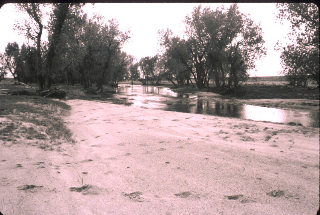
    Then, there is the Sand Creek Massacre.  I’ve been at the site several times.  Sat in the grass
    by Sand Creek, camera in hand, alone, recording sounds, the sun warm on my back.  I felt like
    others were there.  You know, invisible, but there.  Perhaps apparitions, if I looked hard enough.
    On November 29, 1964, there were over five-hundred Cheyenne lodges there, perhaps a thousand
    or so Cheyenne people, seven-hundred soldiers, their horses, their equipment, their canons,
    their guns, their sabers, and Indian dogs and horses.  Their ignorance.  Their fear.  Their  hate.
    And there was murder there.  Rape. Mutilations.  Carnage.

    There is a prominent person who has done work at the Sand Creek Massacre Site.  I asked
    her if she ever “felt” anything while she was there doing her work.  She said, “No, not really, but I’ll
    never go out to the site at night.”  I asked her why.  She said, “I don’t know why, I just won’t go.”

    You might want to check it out, see how it makes you feel.  Perhaps it can remove you,
    even for a moment, from your reality and plunge you in the depths of losing sight of who
    human beings, all human beings really are, human beings, just like you and me.

    ####

    Contact:

    Donald L. Vasicek
    Olympus Films+, LLC

    The Zen of Writing


    dvasicek@earthlink.net
    303-903-2103

  • Witness Account

    The Sand Creek Massacre Witness Account:

    One Story of Horror At Sand Creek Duncan Kerr, the scout, found the body of One Eye lying near the camp.
    “Some of the boys had scalped him, ” Kerr wrote, “but they either did not understand how to take a scalp, or their knives were very dull, for they had commenced to take the scalp off at the top of the head, and torn a strip down to the middle of the neck.”

    A short distance beyond, he found One Eye’s wife sitting alone in a buffalo wallow: “I went up to her and laid my hand on her head. She looked up quietly, and recognizing me said; ‘How de do Dunk, me heap dry. Gib me some water.’

    I asked in the Cheyenne language, if she was seriously hurt. She replied by throwing the blanket back and showing me aghastly wound in her side, through which the entrails were protruding. The wound must have been caused by a fragment of a shell.  I gave her a drink of water, and left my canteen. As I turned to leave, she took my hand to detain me, and begged me to shoot her with my gun….But I could not do it, for I had known her a long time; a lively, sprightly, mischievous, little thing, that fairly worshipped her Chief One Eye.

    This is the squaw that One Eye brought into Ft. Lyon with him and was on our trip after the captives. When she saw I would not kill her she covered up her head and began singing her death song again….I had not gone very far, when I met a soldier.  I pointed her out to him, and told him I had just shot and wounded an Indian and had fired my last shot; that the Indian was badly wounded, and could not help himself, and I wanted him to creep up behind the Indian and shoot him in the back of the head. The fellow crept up close behind her and shot her dead….
    -“Sand Creek: Tragedy and Symbol Pt. 1” G.L.Roberts, 1984

    Sand Creek
    Sand Creek in southeastern Colorado